

Digital Marketing or SEO: Should You Learn Everything First or Specialize?
If you are new to the field, learning the fundamentals of digital marketing before you decide whether to specialize in SEO or not is important. You do not need to master every channel before deciding on a direction. You must have enough experience to grasp what SEO accomplishes, how it relates to other tasks, and whether you love performing it.
There is one exception: if you’ve already tried SEO and know what you want to focus on, a specialist course could be a good place to start. Whether you’re considering digital marketing certification in Zirakpur or learning online from anywhere in India, the most crucial step is to check the actual curriculum/syllabus. A course name alone does not indicate how much time you will devote to organic SEO, sponsored search, content, or AI tools.
Here’s how you will be able to decide practically.
What’s the difference between learning digital marketing and SEO?

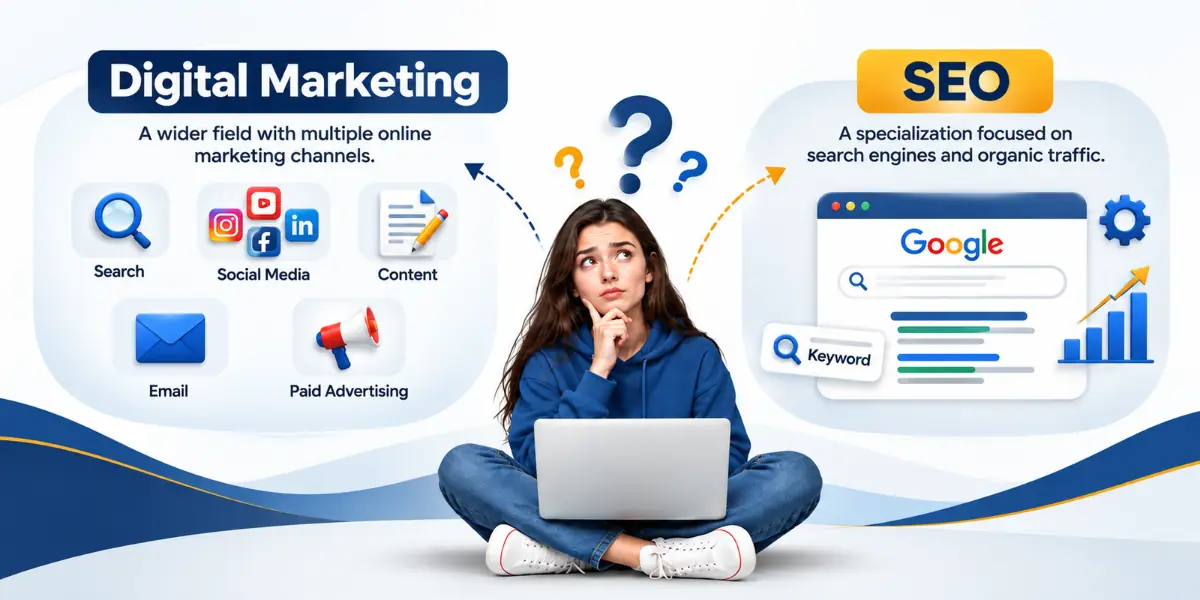
Digital marketing is a wider field. While it prepares a person with different ways to reach and engage with a relevant audience online, such as search, social media, content, email, and paid advertising, SEO is a specialization in one of the methods included in digital marketing.
Speaking of SEO, or search engine optimization, it focuses on making relevant website pages more discoverable through organic search and useful to those who find them.
Consider a student choosing a course online. They may notice an Instagram post, search Google for course information, read a website page, evaluate possibilities, and then submit an inquiry. A digital marketer could work on multiple of those steps. An SEO specialist would focus more closely on the search queries, website pages, and search performance.
Neither path is necessarily better. They assign you distinct learning priorities.
Why Start Broad if You Are Unsure?
It is difficult to know which part you will enjoy when you are at the very beginning of your search.
Watching an SEO video differs from spending an afternoon analyzing website pages and explaining how you can improve them.
A broad foundation allows you to explore a variety of tasks before making a more specific decision. You may find that you prefer:
- Search research entails identifying common questions and determining which pages provide answers.
- Writing and editing are processes that improve the clarity and utility of information.
- Advertising involves testing messaging, audiences, and campaign settings.
- Analytics: Investigating what occurred and determining what should be changed.
- Social content: Turning an idea into a format people will engage with.
Starting broad also helps you understand where SEO fits. If you eventually become an SEO specialist, you will still need to explain how your work connects to website experience, enquiries and other marketing activity.
But “start broad” does not mean collecting dozens of tool names. It means doing enough work in each area to make an informed choice.
When does it make sense to specialize in SEO early?
You may be ready to focus on SEO sooner if you have already explored it and find yourself drawn to the work.
Ask yourself whether you enjoy questions like these:
- Why does one page answer a search better than another?
- What information is missing from this website?
- How should several related pages be organized?
- What might explain a change in search traffic?
- How can I make a complex topic easier to understand?
You do not need to know the answers yet. Interest in investigating them is a good sign.
Specialization is also reasonable if you have a specific goal. For example, you may already create website content and want to learn how to research search intent, improve pages, and measure their visibility. In that case, another broad introduction may repeat too much of what you know.
Be specific about what you mean by SEO. If your main interest is organic website visibility, check that the training includes substantial practice with SEO research, website pages, technical basics, content, and measurement. A course centred on Google Ads may teach valuable search marketing skills, but paid search and organic SEO are different kinds of work.
Do you have to choose one career path forever?

No. Your first course is a starting point, not a permanent label.
A student might begin with digital marketing, become interested in SEO, and later move into content strategy or technical SEO. Another might begin with search, then learn paid campaigns because they want to understand both organic and paid visibility.
A more useful question than “Which one has the best future?” is:
Which kind of work am I willing to practice long enough to become good at?
Do not choose SEO only because you have heard it is in demand. Do not choose a broad course only because the syllabus looks longer. Choose the learning path that lets you build skills, test your interest, and receive feedback.
Where does AI fit into this decision?
AI tools are designed to support both digital marketing work and SEO work on a wider spectrum. Knowing them well will help further in organizing research, suggesting content angles, or speeding up a first draft.
Let’s say there is a business that you know well; an AI for SEO course curriculum helps you understand what a particular audience needs and take more probable action on how the business can progress in search results.
That is why AI-powered digital marketing training should teach you how to check and improve AI output, as well as how to use a tool. The same standard applies to an AI-powered digital marketing course: look for practice and feedback behind the AI terminology.
If you are comparing an AI SEO course with a general program, ask:
- Does it teach SEO fundamentals before AI-assisted workflows?
- Will I review actual website pages?
- How will I check whether an AI-generated suggestion is accurate?
- Will I learn to measure results or only generate content?
- What work will I have completed by the end?
An AI for SEO course includes studying how to recognize the difference between real-time data and AI-suggested numbers. If the suggested research stands out from the assumptions, crawling in the market for a particular business type is one of the broad study areas when it comes to an AI SEO course.
What about AEO, GEO, and AI search?
Squad Industrial Training’s AI-powered digital marketing course descriptions may include terms such as AEO (answer engine optimisation) and GEO (generating engine optimization). These concepts are used to describe visibility in answer-based and AI-generated search experiences.
As a student, you should understand what they are referring to. You should also consider what you will do with this knowledge. Will you improve a site that answers a valid question? Check if the information is correct and easy to discover. Learn how search visibility is measured.
Be careful of any promise that one unique format will cause a site to appear in an AI response. According to Google’s guidelines, conventional SEO principles continue to apply to AI features such as AI Overviews and AI Mode; there is no distinct technological need or guaranteed placement.
For a newbie, the obvious order is SEO foundations first, then AI-assisted work, and finally modifying search experiences in context.
How can you choose between the two paths?
Use this short decision check before paying for training.
Choose a digital marketing training program first if:
- It’s your beginning, and you want to explore several areas.
- You prefer more than one field to explore, like writing, keyword research, ads, analytics, or social media.
- You want to understand practically how different segments in digital marketing connect.
- You want to compare your strengths by analyzing your performance in assignments.
Consider an SEO-focused training program first if:
- You already have basic SEO work experience and want to gain more expertise.
- You prefer working on frequently asked questions and improving website pages.
- You are comfortable spending time investigating details and reviewing results.
- The course syllabus clearly matches the type of search work you want to learn.
Pause before choosing either course if you cannot tell what you will practice. Ask to see the module breakdown, assignment examples, and expected outputs. “Includes AI” and “covers everything” are too vague to make a good decision.
What should you ask Squad Industrial Training?
Squad Industrial Training offers a Digital Marketing, SEO, and AI Integration program that includes SEO, content, social media, ads, email, analytics, and AI tools. The website also features an AI SEO program. Options for offline and online digital marketing training in Zirakpur and Faridabad are listed on the website.
Enquire about the assignments you will do, how your work will be examined, and what the certificate confirms. According to the digital marketing training course page, students can get a training completion certificate once they have completed assignments.
If online digital marketing certification in Zirakpur is more convenient for your schedule than attending in person, enquire about how live sessions, project feedback, and doubt resolution operate in the online format. The learning mode should allow you to practise and ask questions, not just watch sessions. Squad’s website includes both online and physical solutions.
For the search-focused option, ask one especially direct question: “How much of this course covers organic SEO, and how much covers Google Ads?” That answer will help you in determining the best course of action for your specific interests.
FAQs
If you are completely undecided, a broad foundation can help you discover whether SEO is the area you want to pursue. You do not need to master every digital marketing channel before learning SEO in depth.
That is not a useful comparison. SEO is one part of digital marketing. A focused syllabus may have fewer topics, but developing skill in those topics still takes practice and patience.
It depends on the depth of your SEO practice, the work you can show, and the employer’s requirements. Covering SEO in a syllabus is a starting point; doing and explaining SEO work is stronger evidence of skill.
Beginners can learn to use AI tools while studying SEO. Check that the course also teaches search intent, website pages, content quality, and measurement. Learning prompts without those foundations leaves a significant gap.
The decision in one line
Learn broadly enough to choose with confidence, then go deep enough to show real skill. If you are unsure, start with digital marketing foundations. If you already know that you enjoy search work, compare specialist syllabuses carefully and choose the one that teaches the SEO work you actually want to do.