

What Is an API Gateway? A Beginner’s Guide to How It Works
1. What is an API Gateway?
For a beginner stepping into backend development, understanding complex systems can feel overwhelming. Let me simplify it with a real-world analogy.
Imagine walking into a massive shopping mall with hundreds of stores. You don’t want to visit every shop to find what you need. Instead, you go to the information desk. You tell the person there, “I need running shoes,” and they point you directly to the right store.
An API gateway works the same way—but for software applications.
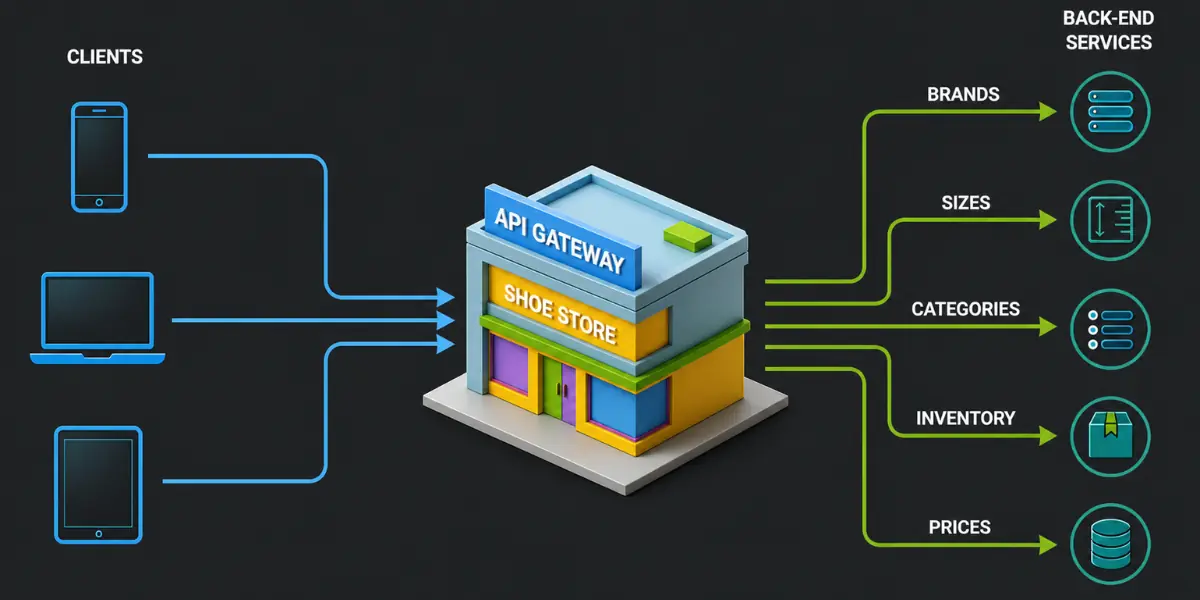
An API gateway is a single entry point between client apps (mobile apps and websites) and backend services. Every request arrives at the gateway first. The gateway then figures out which backend service should handle it.
In modern systems, especially when using the API Gateway in microservices, this centralized entry point becomes essential for managing complexity.
Without a gateway, your app would need to know the address of every backend service. That becomes messy very fast.
2. How does an API Gateway work?
If you’re wondering what actually happens inside the gateway, let me walk you through it step by step.
Step 1 — Client sends a request
A user opens a ride-hailing app and requests a car. The app sends one request to one URL — the API Gateway.
Step 2—Gateway check security
The gateway verifies if the request is legitimate. It checks authentication [confirming user identity] tokens and rate limits [restricting how many requests a user can make].
Step 3 — Request routing
The gateway examines the request details and determines where to route it. This routing plays a key role in microservices communication, ensuring each request reaches the correct service.
Step 4—Request aggregation
The gateway may talk to multiple services at once—driver location, payment status—and then combine everything into one response.
Step 5 — Return the response
The client receives one complete response. The user never knows that multiple services were involved.
The key takeaway is this: the gateway hides all internal complexity.
3. Why use an API Gateway in a microservices architecture?

For a student learning about modern software architecture, the term “microservices” appears everywhere. Let me explain why the API Gateway becomes essential here.
Microservices mean splitting an app into smaller, independent services that operate together as a system. The API Gateway in microservices helps manage this structure efficiently.
For example, an e-commerce app might have a user service, product service, order service, and payment service, all relying on structured microservices communication patterns.
What happens without an API Gateway?
Your mobile app needs to know the addresses of all four services. If any address changes, your app breaks. You also write the same security code four times.
What happens with an API Gateway?
Your app calls one URL—the gateway. The gateway routes each request correctly. Security happens in one place. If a service address changes, you only need to update the gateway.
Any student building their first microservices project will discover the API Gateway isn’t optional—it’s the glue holding everything together.
Make Microservices Simple & Scalable!
Without an API Gateway, your app gets messy fast. With one, you gain a single entry point, better security, and seamless service communication.
Simplify Your System Today!
4. What are the risks of implementing an API Gateway?
No technology is perfect. Before adding an API Gateway, you need to understand the trade-offs.
Risk 1: Single point of failure
If the gateway goes down, everything stops. No client reaches any backend service.
Fix: Deploy multiple gateway instances across different servers.
Risk 2: Extra network latency [delay]
Every request takes one additional hop — to the gateway first, then to the backend.
Fix: Use caching [storing frequent responses] at the gateway level.
Risk 3: Configuration complexity
You must set up routing rules, authentication policies, and rate limits.
Fix: Start simple. Add features gradually as your needs grow.
Remember: API Gateway in microservices solves real problems but introduces new ones. Plan for both sides. Also, inefficient microservices communication can increase system load if not handled properly.
5. How does an API Gateway compare to other infrastructure components?
For a beginner who confuses API gateways with reverse proxies and load balancers, you’re not alone. This is one of the most common questions. Let me clear it up.
| Component | Primary Job | Best For |
| Load Balancer | Distributes traffic across multiple servers | Preventing server overload |
| Reverse Proxy | Hides backend servers, handles SSL [security certificate] |
Simple traffic forwarding |
| API Gateway | Routing + security + rate limiting + aggregation | Microservices and complex systems |
A student trying to remember the difference can use this simple memory aid:
- A load balancer is a traffic cop at an intersection.
- A reverse proxy is a reception desk masking internal offices.
- An API Gateway is the receptionist, security guard, and traffic manager combined, following the API Gateway pattern.
If you’re working on a small project, a reverse proxy might be enough. But once you have multiple microservices and strict security needs, the API Gateway becomes the right tool for the job.
You’re closer than you think.
You just added a new tool to your backend toolkit. Understanding API Gateway in microservices opens doors to modern architecture. That’s not small — that’s real growth. Celebrate this win. Then take the next small step. Every expert got there the same way: one topic at a time.
Small Step, Big Upgrade
You now know how one gateway can manage routing, security, and service changes effortlessly. That’s how modern apps stay fast and scalable.
Level Up Your Skills!
FAQs
It acts as a single entry point for an API Gateway in microservices, routing client requests while managing security and centralizing backend access.
Load balancers distribute traffic across servers, while gateways manage microservices communication by routing requests based on specific paths or user needs.
Reverse proxies work for simple setups, but gateways are better for advanced microservices communication patterns like request aggregation and rate limiting.
It adds minor latency. However, it organizes traffic efficiently, and using caching can significantly speed up the delivery of frequent data.
Yes. To protect your system, you must run multiple instances so it remains available even if one central gateway component fails.
Start once managing multiple backend URLs manually or repeating security code across different services becomes too difficult to maintain and scale.